

Just like companies, higher ed marketers don’t have unlimited budgets. Every branded merch decision involves balancing cost, reach, quality, and impact.
A new consumer study from the Promotional Products Association International (PPAI), based on responses from more than 3,400 U.S. consumers, reinforces something many enrollment and advancement teams already know: people keep branded merch that’s useful, relevant, and fits into their lives.
For colleges and universities, that’s an important reminder. Success isn’t about buying the most expensive item. It’s about choosing the right item for the right audience and purpose.
Earlier this year, we explored how branded merch builds identity, belonging, and emotional connection in higher ed. The PPAI research adds another layer by showing what makes people keep and use it.
Utility Comes First
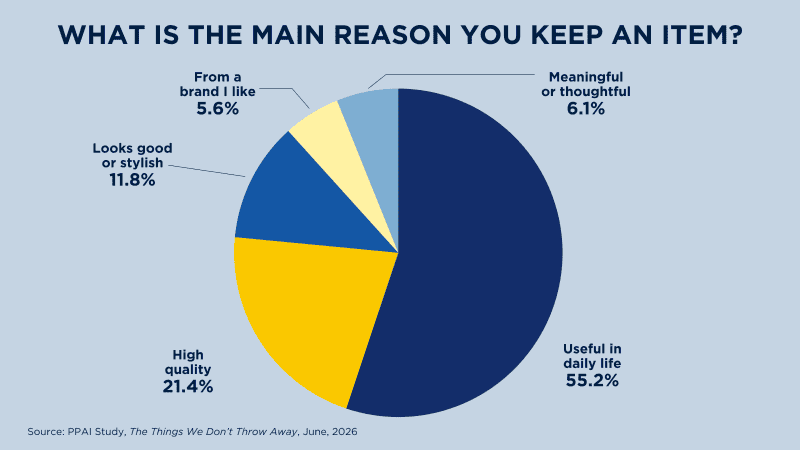
According to the study, 55% of consumers said the main reason they keep branded merch is because it’s useful in their daily lives. Another 21% keep items because they’re high quality. The leading reason people discard branded merch is that it isn’t useful.
That has clear implications for higher ed.
A reusable water bottle. A luggage tag. A notebook used during orientation. A calendar displayed in an alum’s office. Each has a purpose.
The best branded merch becomes part of someone’s routine.
Match the Product to the Moment
Not every campaign has the same objective, and not every audience needs the same product. Merch for a campus visit serves a different purpose than a donor appreciation gift or an admitted student mailing.
Sometimes you need to reach thousands of people within a fixed budget. Practical, well-designed products can be exactly the right choice.
Other times, you’re recognizing a major donor, celebrating a milestone, or creating a premium admitted student experience. That’s when investing in higher-end merch may make sense.
The research doesn’t suggest every item should be premium. It suggests recipients notice when products feel intentional, useful, and appropriate for the occasion.
Focus on Fit, Not Just Cost
The study found that 66% of consumers would rather receive fewer, higher-quality items than more lower-cost ones.

That doesn’t necessarily mean institutions should order fewer products. It suggests being more strategic about what you distribute, to whom, and when.
Ask questions like:
- Who is this audience?
- What are they likely to use?
- How long do we want this item to stay visible?
- What role does this product play in the larger campaign?
The answers lead to better outcomes than simply choosing the lowest-priced option.
Merch Creates More Than One Impression
Branded merch continues working long after distribution.
Nearly half of respondents said branded merch prompted them to look up a brand. More than 40% visited a website, nearly 39% made a purchase, and 38% talked about the brand with others.
In higher ed, those actions may look different. A prospective student may visit an admissions website after receiving a mailing. An alum may think about their institution every time they use a branded calendar or notebook. A donor may be reminded of their giving experience and decide to give again.
Useful merch becomes another touchpoint in your recruitment, engagement, or advancement strategy.
The Product Represents the Brand
Nearly 90% of consumers said receiving high-quality merch improved their perception of a brand.

Every branded product represents your institution. Whether it’s a sticker, t-shirt, notebook, or premium gift, it contributes to your brand experience.
Quality doesn’t always mean choosing the most expensive product. It means choosing products that fit your audience, perform well, and reflect your institution.
The PPAI research points to a simple conclusion: the most effective branded merch isn’t necessarily the most expensive. It’s the merch people choose to keep and use.
That’s where lasting impressions begin.